
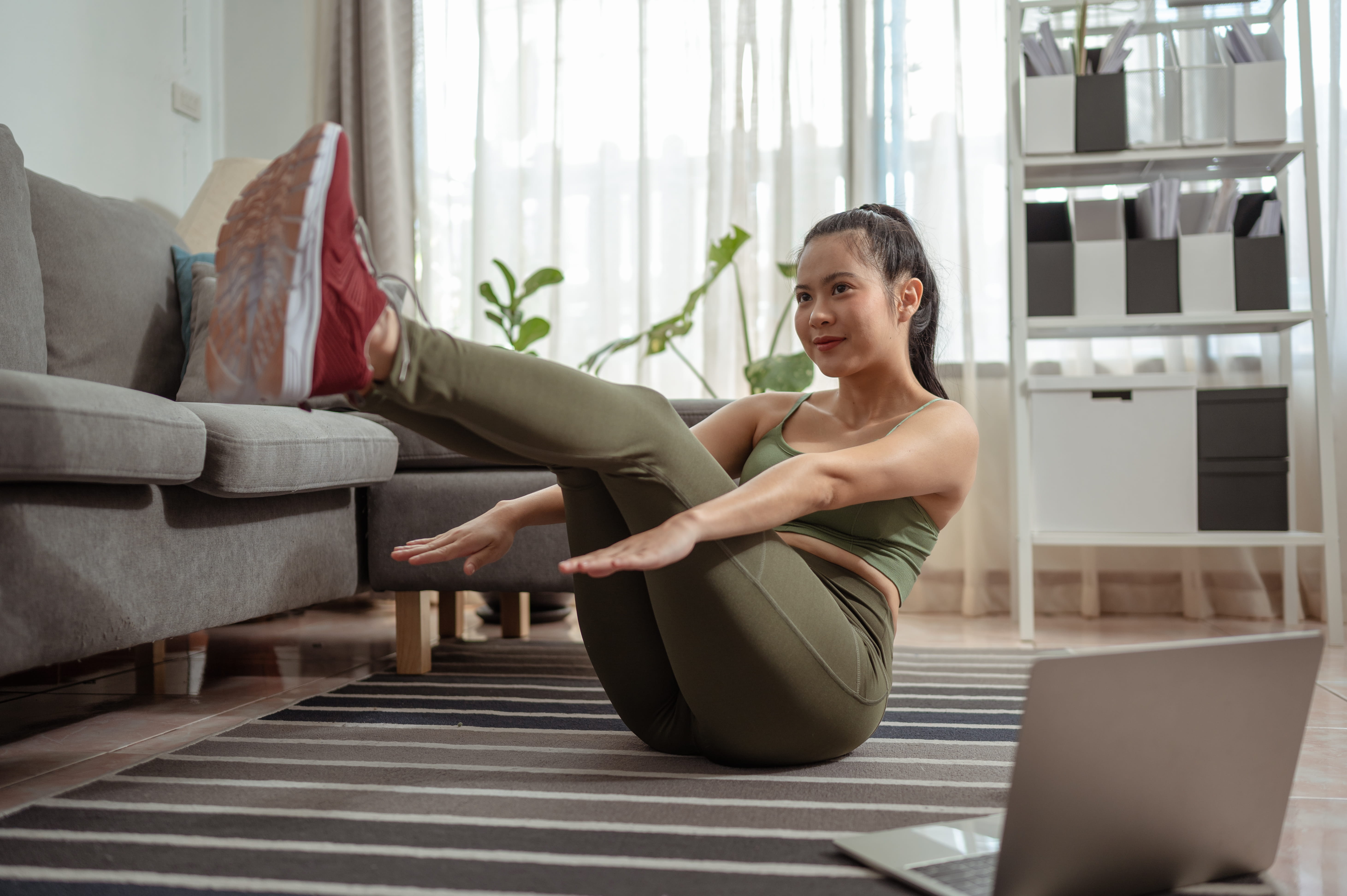
The hip joint moves in six directions, and stiffness in any of them can shift mechanical stress to the lower back, knees, and ankles. Desk work, prolonged sitting, and repetitive activities can cause muscles like the hip flexors, piriformis, and adductors to shorten and tighten, restricting movement within the joint.
The exercises below are designed to help restore range of motion, progressing from gentle movements suitable for significant stiffness to more demanding positions for those working on performance.
Hip Anatomy and Movement Patterns
The hip is a ball-and-socket joint where the femoral head articulates with the pelvic acetabulum, relying on a balance between stability and mobility across roughly 21 crossing muscles and a fibrous joint capsule.
- Flexors, extensors, abductors, and rotators work together to bring the thigh forward, drive it backward, move it sideways, and control internal and external rotation
- The joint capsule, reinforced by three ligaments and containing synovial fluid, can develop restrictions from prolonged positioning, previous injury, or inflammatory conditions
- Capsular tightness often creates a firmer end-feel at the movement barrier, while muscular tightness tends to produce a more gradual, elastic resistance
- Effective mobility work generally addresses both components, with dynamic movements warming the capsule and sustained positions lengthening specific muscle groups
Daily Hip Mobility Routine
This sequence takes around 12 to 15 minutes and addresses all six movement directions. Perform on a firm surface with a yoga mat for comfort.
Hip Switches
Sit with both knees bent at 90 degrees, one leg in front and one behind. Your front shin should be roughly parallel to your chest. Rotate your torso towards your front knee while keeping your spine tall. Hold for around 30 seconds, then lift both knees and switch to the opposite configuration. This exercise targets external rotation of the front hip and internal rotation of the back hip at the same time. Complete around 5 switches per side.
Half-Kneeling Hip Flexor Mobilisation
Kneel on your right knee with your left foot flat on the floor ahead. Tuck your pelvis under, imagining bringing your belt buckle towards your belly button. This posterior pelvic tilt helps intensify the stretch on the hip flexors without extending through your lower back. Shift your weight forward slightly until you feel tension in the front of your right hip. Hold for around 45 seconds. For increased effect, raise your right arm overhead and lean slightly left. Repeat on the opposite side.
Supine Figure-Four Stretch
Lie on your back with knees bent. Cross your right ankle over your left thigh, just above the knee. Thread your hands behind your left thigh and draw it towards your chest. The right knee should press gently away from your body. This position targets the piriformis and deep external rotators. Hold for around 60 seconds per side, breathing deeply to encourage tissue relaxation.
Frog Stretch Progression
Start on hands and knees. Widen your knees as far as comfortable with feet turned outward, inner edges resting on the floor. Rock your hips backward towards your heels, then forward towards your hands. This dynamic movement mobilises the hip joint in abduction while stretching the adductor muscles along the inner thigh. Perform around 15 to 20 slow rocks, gradually increasing your knee width as tolerance allows.
Did You Know? The hip joint capsule is supported by three primary ligaments (iliofemoral, pubofemoral, and ischiofemoral), each helping limit specific excessive movement directions. The iliofemoral ligament is recognized as one of the strongest ligaments in the human body, supporting hip stability during standing.
Exercises for Specific Hip Restrictions
Anterior Hip Tightness
Front-of-hip restriction typically involves shortened psoas and iliacus muscles, collectively known as the iliopsoas. Beyond the half-kneeling stretch, the couch stretch offers a more intense option. Position yourself in a half-kneeling stance with your back foot elevated on a couch or chair behind you. The elevated position increases hip flexor lengthening. Maintain a posterior pelvic tilt throughout.
Lateral Hip Restriction
Side-of-hip tightness generally involves the gluteus medius and tensor fasciae latae. The pigeon pose variation addresses this: from hands and knees, slide your right knee forward and outward while extending your left leg behind you. Keep your hips square to the floor. If your right hip doesn’t reach the floor, place a folded towel underneath for support. Hold for around 90 seconds per side.
Posterior Hip Stiffness
Back-of-hip restriction generally involves the gluteus maximus and deep rotators. The seated piriformis stretch, sitting with one ankle crossed over the opposite knee and folding forward, directly targets these structures. For increased intensity, this can be performed while lying on your back, using your hands to draw the bottom knee towards your chest.
Internal Rotation Deficit
Many individuals lack internal rotation from prolonged sitting. The sleeper stretch adaptation works well: lie on your side with your top leg bent at 90 degrees. Use your top hand to press your foot towards the floor while keeping your knee stationary. This internally rotates the hip against gravity’s resistance.
Progressive Hip Mobility Exercises
Once basic mobility improves, these exercises can help challenge end-range control and build strength in newly available positions.
Controlled Articular Rotations
Stand on one leg, holding a wall for balance. Lift your opposite knee to hip height. Slowly trace the largest comfortable circle with your knee (forward, out to the side, behind you, and back to the start). Move at the edge of your available range without compensating through your spine or pelvis. Perform around 3 circles in each direction per hip. This exercise aims to explore and gradually expand joint capacity while building neuromuscular control.
Deep Squat Hold with Rotation
Assume a deep squat position with feet shoulder-width apart, toes slightly turned out. Hold onto a doorframe or sturdy furniture for support. Shift your weight to one foot and drop the opposite knee inward towards the floor, then lift it outward. This movement cycles through internal and external rotation under load. Complete around 8 to 10 rotations per side.
Single-Leg Romanian Deadlift
This exercise challenges hip stability while lengthening the hamstrings dynamically. Stand on your left leg with a slight knee bend. Hinge forward at your hip while extending your right leg behind you for counterbalance. Reach towards the floor with both hands. Return to standing by driving through your left hip. Perform around 8 to 10 repetitions per side with a controlled tempo.
Important Note: Sharp, catching pain during any hip exercise, particularly in the groin or deep in the joint, warrants stopping immediately. This differs from the mild discomfort of stretching tight tissues and may indicate labral or cartilage involvement requiring professional assessment.
Common Mistakes That Limit Progress
Forcing Range Before Tissue Readiness
Aggressive stretching can trigger a protective contraction that opposes lengthening. Effective mobility work generally operates at moderate intensity, around 6 out of 10 on a discomfort scale, where tissues can adapt without defensive responses. Pain during stretching generally indicates excessive intensity.
Compensating Through the Lumbar Spine
The lower back often substitutes for limited hip movement. During hip flexor stretches, an anteriorly tilted pelvis (arched lower back) reduces hip extension and shifts the stretch to spinal structures. Maintaining a neutral or posteriorly tilted pelvis helps isolate hip tissues.
Inconsistent Practice
Muscles and surrounding soft tissues respond to regular stimulus. Regular daily practice is often considered more supportive of tissue adaptation than infrequent weekly sessions.
Neglecting Rotational Movements
Flexion and extension exercises dominate many routines, leaving rotational capacity underdeveloped. The hip requires internal and external rotation for walking, stairs, and athletic movement. Including rotation-specific exercises in every session is generally recommended.
Clinical Insights
Clinical examination often reveals that patients presenting with hip stiffness have specific movement deficits that can respond well to targeted exercise. However, underlying structural issues, such as cartilage wear, labral tears, or early arthritic changes, can sometimes limit the effectiveness of mobility work alone. When exercises performed correctly for several weeks fail to improve symptoms, imaging studies can help identify whether tissue-level changes require additional attention.
Quick Tip: Consider performing hip mobility exercises after a brief warm-up, such as walking or marching in place, rather than from a cold start. Elevated tissue temperature may improve muscle pliability and joint fluid viscosity, which can support exercise effectiveness.
Building Your Hip Mobility Practice
Start with assessment. Note which movements feel restricted. Compare right to left.
Consider whether limitations occur early in the range (which may suggest capsular involvement) or at end-range (which may suggest muscular tightness).
Prioritise your greatest deficit. If internal rotation is significantly limited while flexion is adequate, it may help to emphasise rotation-specific exercises rather than general stretching.
Progress gradually. Spending around two weeks on foundational exercises before advancing to loaded or end-range positions is generally advisable. Rushing progression can sometimes cause setbacks.
Integrate with daily activities. The deep squat position while reading, the 90/90 sit while watching television, or standing hip rotations while waiting can all help accumulate mobility stimulus without dedicated exercise time.
Track changes monthly. Photographing or recording your movement positions can help objectively assess improvement, since subjective feeling often underestimates actual progress.
When to Seek Professional Help
- Groin pain that worsens with hip flexion activities like climbing stairs or getting into cars
- Clicking, catching, or locking sensations within the hip joint during movement
- Pain that radiates from the hip into the thigh or knee
- Limping that persists after warming up
- Inability to bear weight on one leg without discomfort
- Night pain that disrupts sleep
- Hip stiffness that fails to improve after six weeks of consistent exercise
- Asymmetry between hips that worsens over time
Commonly Asked Questions
How long until hip mobility exercises produce noticeable results?
Muscular flexibility typically improves within two to three weeks of consistent practice. Joint capsule changes generally require longer, often six to eight weeks of regular stimulus. Functional improvements in activities like squatting or walking often become apparent before measured range of motion increases.
Should hip mobility exercises cause discomfort?
Mild stretching sensation and muscular discomfort are normal and expected. Sharp pain, joint pain deep within the hip, or symptoms that persist after exercise may indicate either excessive intensity or an underlying issue that warrants assessment.
Can hip mobility exercises help with lower back pain?
Hip restrictions can contribute to lower back symptoms by forcing the lumbar spine to compensate for limited hip movement. Restoring hip mobility may help reduce mechanical stress on spinal structures, though primary spinal conditions require their own specific treatment.
How often should I perform hip mobility exercises?
Daily practice of around 10 to 15 minutes tends to produce faster adaptation than longer sessions performed less frequently. The hip joint generally responds well to consistent, moderate stimulus rather than infrequent intensive stretching.
Are hip mobility exercises safe after hip replacement surgery?
Post-surgical mobility exercise follows specific protocols determined by the surgical approach and implant type. Your orthopaedic surgeon can provide individualised guidance, typically progressing from protected movements to fuller mobility work over several months.
Next Steps
Daily hip mobility practice of around 10 to 15 minutes tends to produce more consistent results than infrequent, intensive sessions. Identify your specific movement deficits, particularly internal rotation, which is commonly neglected, and prioritise exercises targeting those restrictions. If groin pain, catching or locking sensations, or hip stiffness persist after six weeks of consistent exercise, structural factors such as labral tears or hip impingement may be involved and are worth having assessed.
If you are experiencing groin pain with hip flexion, clicking or catching sensations within the joint, or stiffness that has not improved after six weeks of consistent exercise, an orthopaedic surgeon can assess your condition and discuss suitable treatment options.